Picture a Lakeland home after one of those loud summer thunderstorms that roll across Polk County almost every afternoon. From the outside, the shingles look fine, and nothing blew off. A few days later, however, a tan ring appears on the ceiling beside the fireplace, right where the chimney passes through the roof. More often than not, a stain in a spot like that points to damaged flashing.
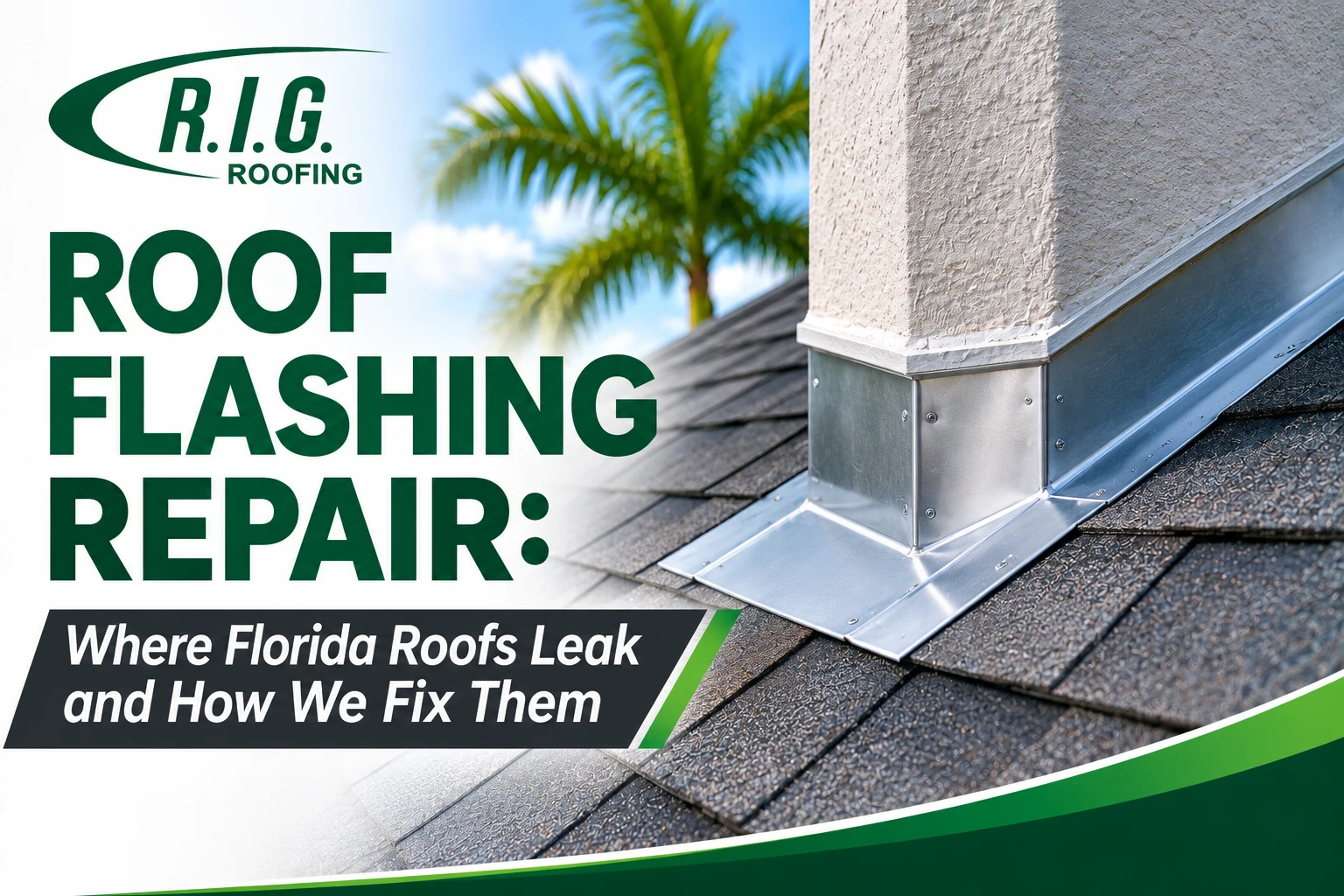
A flashing repair means fixing or replacing the thin metal that seals the joints of your roof, such as chimneys, walls, vents, skylights and valleys. In Florida, these spots are where most leaks begin. Heat, sun and wind driven rain can wear down sealants and loosen metal long before the whole roof fails. A proper repair removes the damaged roof covering around the problem, replaces the flashing and underlayment as well as the damaged roof covering (shingle, metal, tile) and seals everything back to code. In most cases, it does not require a full roof replacement.
Before deciding whether your leak is a flashing problem, it helps to understand what flashing actually does.
What Roof Flashing Does on a Florida Roof
Flashing is the metal underneath the main roof covering that directs water away from the places where your roof meets something else. The roof covering sheds rain well across open slopes. Yet every roof is interrupted by vents, walls, chimneys and valleys, and each of those joints is a place that water can settle.
That is why the Florida Building Code, Residential calls for flashing at wall intersections, changes in slope and roof openings. In other words, flashing is not an extra. It is the part of the roof system that keeps those weak points watertight.
Our guide to understanding roof flashing covers the metals and styles in detail. In this article, the we are discussing where flashing fails, because that is where most repair calls start.
Where Florida Roofs Leak: The Most Common Flashing Trouble Spots
Flashing problems tend to show up in the same handful of places on almost every home. Knowing them makes it easier to connect a ceiling stain to its real source.
1. Plumbing Vent Boots and Roof Penetrations
Most shingle roofs have several plumbing vent pipes, and each one is sealed with a pipe boot. Many boots use a rubber collar that hugs the pipe. Unfortunately, years of Florida sun dry that rubber out until it cracks and pulls away.
2. Chimney and Sidewall Flashing
Where a roof slope runs into a wall or chimney, the seal depends on two layers working together. Step flashing is woven between each course of shingles, while counter flashing laps over it from the wall above. On the block and stucco homes common across Central Florida, that counterflashing is often tucked behind the stucco. Over time, stucco cracks or sealant shrinks, and water slips behind the metal. Consequently, many leaks near a wall are blamed on the roof covering when the flashing is the real culprit.
3. Roof Valleys
Valleys carry more water than any other part of the roof because two slopes drain into them. When oak leaves and pine needles pile up there, water backs up and can be pushed sideways under the roof covering. Valley metal can also corrode, and a valley cut too short during installation leaves the edge exposed. On a tile roof, a clogged or worn valley is one of the most common causes of a leak, even when every tile seems fine.
4. Skylights, Drip Edge and Roof Edges
Skylights rely on their own flashing kits, which can loosen as the frame expands and contracts in the heat. Meanwhile, the drip edge along the eaves and rakes protects the edge of the roof deck. If it is bent, loose or missing, wind driven rain can wick into the decking and fascia.
Because these trouble spots are easy to miss from the ground, the next step is learning which warning signs point back to them.
Signs Your Roof Flashing Needs Repair
Flashing problems usually announce themselves indoors before anything looks wrong outside. For safety, please check from the ground and from inside the house, and leave the climbing to a licensed roofer. After a heavy rain, watch for the following.
- Water stains on the ceiling near a chimney, an exterior wall, a skylight or directly below a vent pipe
- Damp insulation, dark streaks or daylight around pipes and chimneys when you look into the attic
- Rust, gaps or bent metal where the roof meets a wall
- Cracked, dried rubber collars around plumbing vent pipes
- Heavy layers of tar or caulk smeared around a chimney or vent, a sign of earlier patchwork
- Peeling paint or soft spots on fascia boards beneath a roof edge or valley
Leaks that appear only during wind driven rain are another clue, since that water is pushed sideways past a worn joint. Once you spot one of these signs, the quality of the repair matters as much as the speed.
How We Repair Roof Flashing the Right Way
A lasting flashing repair fixes the joint itself rather than smearing sealant over the surface. Caulk has a place as a finishing detail. However, it is not flashing, and Florida heat breaks it down quickly. Whether you call R.I.G. Roofing or another licensed contractor, this is the process to expect.
- Trace the leak to its source. Water often travels along rafters before it shows up, so a roofer inspects the roof and, when it is safe, the attic.
- Document the problem. You should receive photos and a written scope before work begins.
- Remove the roof covering around the joint. Shingles, tile or metal trim are lifted carefully so the flashing and the deck beneath can be inspected.
- Replace damaged decking and underlayment. Any soft wood is cut out, and fresh underlayment is installed in the repaired area.
- Install new flashing. New step flashing, counterflashing, pipe boots or valley metal go in, lapped so water always flows over each layer, never behind it.
- Restore and seal the roof. The roof covering is installed and fastened to manufacturer and Florida Building Code requirements.
Reusing old flashing is sometimes tempting, but it is rarely worth the risk. For example, GAF's technical bulletin on reusing metal flashings recommends replacing flashing whenever possible. It allows reuse only when the metal is in like new condition. That is why we treat new flashing as standard practice, and our repairs carry a 1 year workmanship warranty. Roof replacements come with a minimum 10 year workmanship warranty.
Flashing Repair on Shingle, Metal, Tile and Flat Roofs
Every roof type uses flashing, but each one handles it a little differently. On a shingle roof, step flashing and pipe boots are the most frequent repairs. As a CertainTeed Select ShingleMaster, we install that flashing to the manufacturer's specifications so the repair matches the rest of the system.
On a metal roof, flashing takes the form of trim pieces, closures and flexible pipe boots made to follow the panel profile. R.I.G. Roofing is a Metal Roof Supply Elite Installer and a TriCounty Metals Masters Edge contractor, so you can trust our expertise.
A tile roof relies on flashing at walls, valleys and penetrations alongside the tile itself, which serves as the primary roof covering. Repairing that flashing means lifting the surrounding tile, replacing the underlayment and flashing, resetting the tile, or replacing tiles as needed. Finally, flat roofs such as TPO use membrane flashing at parapet walls, curbs and drains. On those roofs, the repair membrane is heat welded to the field for a continuous seal.
No matter the material, the bigger question is whether a flashing repair is enough.
Flashing Repair or Roof Replacement?
Most flashing leaks can be repaired on their own, especially on a roof with plenty of life left. Still, the condition of the rest of the roof should guide the decision.
When a Flashing Repair Is Enough
A repair makes sense when the leak is limited to one joint, such as a single pipe boot or one section of wall flashing. It also fits when the surrounding deck is solid and the roof covering is in good shape.
When the Roof Needs More Than New Flashing
On the other hand, new flashing may only buy a small amount of time on an aging roof. That is especially true when several joints are leaking or the decking is soft in more than one area. Since a replacement includes all new flashing anyway, it often becomes the smarter investment. Our guide to the cost of a new roof in Florida explains what goes into that decision.
Frequently Asked Questions About Roof Flashing Repair
Can I fix leaking flashing with roofing caulk?
Caulk can slow a leak for a short time, but it does not replace flashing. Florida heat and UV break down sealant quickly, so the leak usually returns. A lasting repair replaces the damaged metal or pipe boot.
How do I know if my leak is flashing or the roof itself?
Location is the best clue. Stains near chimneys, walls, skylights or vent pipes usually point to flashing. A professional inspection confirms the source.
Does flashing get replaced when I get a new roof?
It should. We install new flashing as part of every reroof, because old metal is often damaged during tear-off or does not match the new roof system.
Is it safe to check my flashing myself?
You can look for stains indoors, check the attic with a flashlight and use binoculars from the yard. Leave anything on the roof to a licensed roofer.
R.I.G. Roofing is a faith based, family owned company that has served Florida homeowners since 2005. Our state licenses are CBC1257644 and CCC1329175, and we are rated A+ by the BBB and Google Guaranteed. Our Winter Haven home office and Lakeland office keep crews close for roof repair in Lakeland and Winter Haven.
If water is coming in right now, our emergency dry in service can protect your home until a permanent repair is made. For the long run, our roof maintenance program checks flashing, pipe boots and valleys before small gaps become leaks.
Seeing a stain by the chimney or a leak below a vent pipe? Call us at 1 (863) 294-4477 or schedule your free roof assessment. We will find the source, show you what we found and give you a clear plan to fix it.
Last updated: November 2026